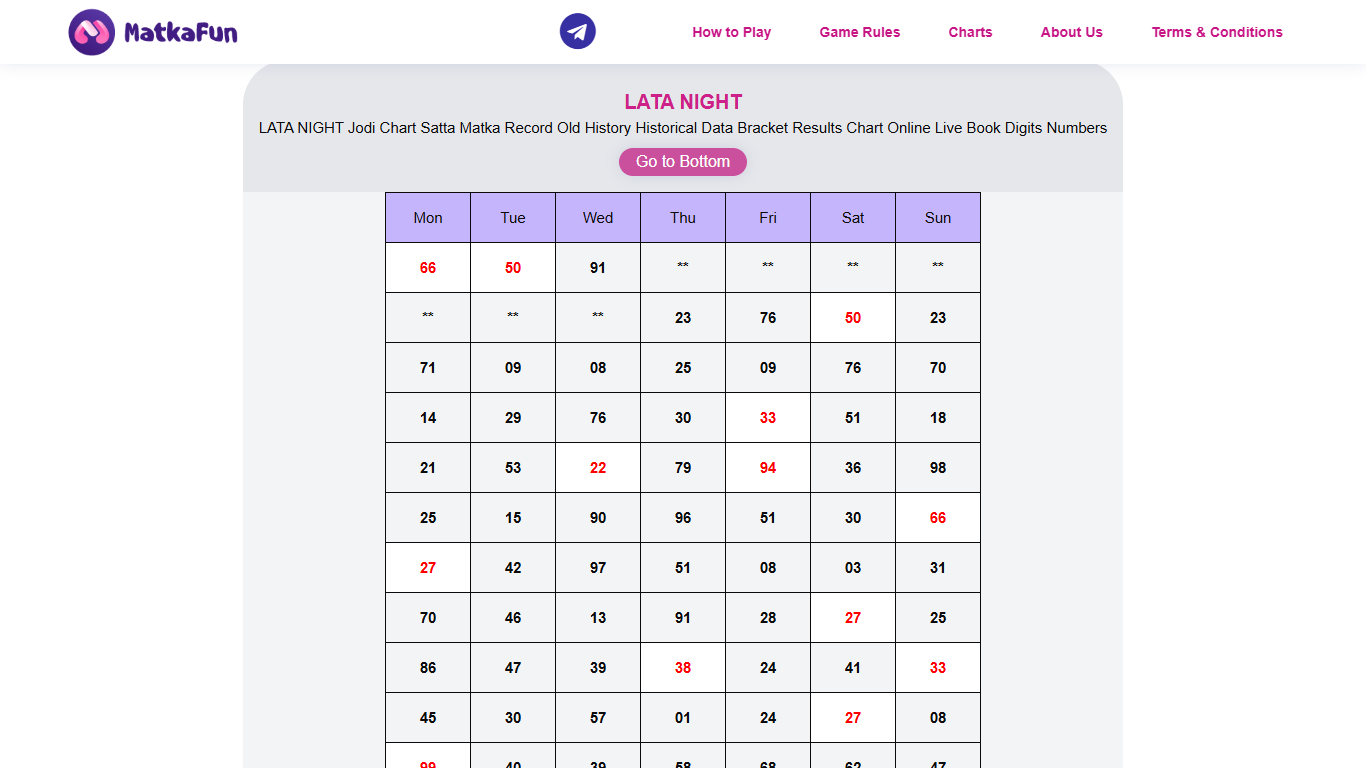
The Lata Night Chart is often reviewed by users who want to understand how night market results are recorded over time. While many people casually check charts, fewer truly understand how to read the numbers correctly and interpret visible patterns responsibly.
This guide explains how lata night chart data is structured, how to read numbers step by step, and how to view patterns realistically—strictly for informational and educational purposes.
What Does “Chart Analysis” Mean Here?
In the context of Lata Night Chart, analysis does not mean prediction. It simply refers to:
- Reading historical data
- Understanding number formats
- Observing how results are displayed
- Reviewing sequences over time
Charts are records of past results, not forecasting tools.
Understanding the Number Formats in Lata Night Chart
Before reading patterns, it’s important to understand the formats used.
Single Digit
- One-digit number (0–9)
- Often part of result breakdowns
Jodi (Pair)
- Two-digit number
- Commonly highlighted as the main result
Patti / Panel
- Three-digit number
- Shown in detailed charts or history tables
These formats exist only to display results clearly.
How to Read Lata Night Chart Step by Step
Step 1: Start With the Date
Charts are arranged chronologically. Always begin by identifying the date you want to review.
Step 2: Note the Displayed Result
The number shown for that date is the officially declared night result.
Step 3: Identify the Format
Check whether the result is shown as:
- Single
- Jodi
- Patti
This helps you understand the chart layout.
Step 4: Move Sequentially
To review history, read the chart day by day or week by week in order.
What People Mean by “Patterns” in Charts
When users talk about patterns, they usually refer to:
- Repeating numbers
- Gaps between appearances
- Visual sequences in charts
- Similar-looking rows or columns
These patterns are visual observations, not functional systems.
Facts About Patterns in Lata Night Chart
Important facts to remember:
- Patterns occur naturally in historical data
- No pattern controls future outcomes
- Each night’s result is independent
- Charts do not influence results
Patterns are coincidental, not predictive.
Common Types of Observations People Make
Some commonly noticed observations include:
- Same jodi appearing more than once
- Numbers not appearing for several days
- Clusters of similar digits
These are normal occurrences in any numerical record.
Mistakes to Avoid While Reading Patterns
Avoid these common mistakes:
- Assuming repetition guarantees future appearance
- Treating charts as prediction tools
- Over-analyzing small data sets
- Ignoring the random nature of results
Understanding the limits of chart data is essential.
Difference Between Observation and Assumption
- Observation:
“This number appeared twice this month.” - Assumption:
“This number must appear again soon.”
Charts support observation, not assumptions.
How Charts Are Meant to Be Used
Lata Night Charts are meant for:
- Historical reference
- Result verification
- Understanding display formats
- Learning how data is recorded
They are not meant for guidance or decision-making.
Why Responsible Chart Reading Matters
Responsible reading:
- Prevents misinformation
- Reduces unrealistic expectations
- Promotes clarity and understanding
- Encourages factual interpretation
Charts are most useful when viewed objectively.
Conclusion
The Lata Night Chart is a structured record of past night market results. Reading numbers correctly and understanding visible patterns helps users follow historical data clearly—but it’s important to remember that charts do not predict or influence future outcomes.
By treating chart analysis as data reading rather than forecasting, users can approach Lata Night Chart information with clarity, realism, and responsibility.
8 thoughts on “Lata Night Chart Analysis Guide: Reading Numbers and Patterns”
Comments are closed.